Brief description and Tips for the skeye.allegro
- Christoph Lechleitner
Introduction
When development on the MDA Client for Android started in spring of 2012, the skeye.allegro was the only device that matched the requirements of our first customer and was actually available on the real world market.
Unfortunately it has initially been developed for Windows CE 6 and Android 2.3.4 was kind of forced on to the very same hardware which, technically, does not even fulfill the screen resolution requirements for Android 2.3.x.
Quick Start Tips
Read the chapter "Android semantics of skeye.allegro's hardware keys"
See below.
Use keys instead of the touchscreen, particulary steering cross, digits, orange function keys
The allegro has a touchscreen, but using the touchscreen requires both hands and can be quite inefficient in rough environments or when wearing gloves.
Most of the time it's easier to use the steering cross of the physical keyboard. Android's UI supports navigation keys better than one might expect, entering text is the only activity requiring to use the touchscreen.
"OK" clicks/activates a selected object (button, icon, ...), the arrows around it are cursor keys, "Esc" usually means "Back".
MDA additionally supports the two orange function keys. For further information see below.
No SMS-style text entry with numeric keys
The digit keys carry markings suggesting it would be possible to enter text like one is used to do when writing SMS on mobile phones without a touchscreen. Unfortunately this is not possible with Android and the current allegro firmware. Furthermore, the '.'-key cannot be used as comma with some languages settings.
Unlocking the Screen
Take the pen or a finger and "drag" the green thing shown on the touch-sensitive screen from the left side to the right side.
It is also possible to disable the screen locker in the settings.
Android semantics of skeye.allegro's hardware keys
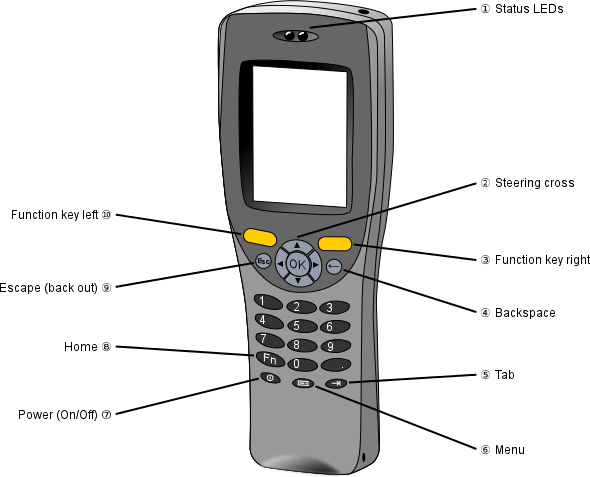
| Android Function | Allegro Key |
|---|---|
| Home | Fn |
| Back | Esc |
| Menu | Menu, center of bottom key row |
MDA support for the orange function keys
Android as operating system and all Android applications we tried so far have no useful function for the two large orange function keys.
MDA however is dedicated to efficient entering of measurement data of considerable numbers of measurements, so we support these two keys for navigation:
- the right function key (labeled ③ in the diagram above) can often be used to go forward to the next page resp. measurement, pressing it has the same effect as touching (clicking) the graphical "next" button displayed on the touch screen.
- the left function key (labeled ⑩ in the diagram above) can often be used to go back to the previous page, pressing it has the same effect as touching (clicking) the graphical "back" button displayed on the touch screen.
The "Esc" button (labeled ⑨ in the diagram above) often has the same effect, but Android's "back" / "back out" semantics furthermore navigates across application layers and even applications.
Status LEDs
Device LEDs
- Left LED:
- permanent or blinking green: System boots or barcode reader is active
- Right LED:
- permanent red: battery charges
- blinking red: battery is fully charged
Docking Station LEDs
- 3 Front LEDs:
- Left LED:
- permanent green: docking station is powered on
- Center LED, only used by LAN:
- permanent yellow: Ethernet link is up
- blinking yellow: Ethernet traffic
- Right LED:
- yellow: USB connection is possible, device is docked and USB cable is plugged in
- Left LED:
- LED near battery charging bay:
- blinks red 1.5s on, 0.1s off: Battery outside temperature for charging
- blinks red 1.5s on, 0.05s off: Battery is fully charged
- blinks red 0.2s on, 0.2s off: Charging aborted, battery propably broken
- LED of Ethernet plug: Unused!
Specification
- CPU Marvell PXA 320 CPU, 806 MHz
- 256 MB RAM, 1 GB Flash
- Card reader: SD and MMC cards, no known size restriction
- Android 2.3.4
- Screen of portrait model: QVGA TFT (240 x 320), 2,8", 64K colors, 4.4x5.8cm, ~140dpi (between "ldpi" and "mdpi")
- Screen of landscape model ("LS"): QVGA TFT (320 x 240), 3,5", 64K colors, ~7.7x5.8cm, ~105dpi ("ldpi")
- WLAN: 802.11a/b/g dual band 2.4/5 GHz , WPA/WPA2/WEP, AES/TKIP
- Bluetooth: Class 2, V2.0+EDR
- Barcode reader: 1D, Laser class 2.
- Environment: IP65, 1.2m fall height, -10° to +50° Celsius
- UMTS: Optonal, not tested by us
Accessories
Docking station models
- USB docking station, model nr. 50250, with USB host port
- LAN docking station, model nr. 50253, with 100 MBit ethernet port, several known problems
Docking station specifications
- Extra battery bay to charge extra battery
- 0° to 40°, recommendation 10° to 30° Celsius
- Battery charge time: ~2.5-3h for standard battery (1800 mAh), ~5 h for large battery (3600 mAh, model nr. 19201)
Further accessories
Further docking station models and other accessories are available, too. For details please visit the product home page which is linked in the introduction at the top of this page.
Known Problems and Solutions
See Known problems of the skeye.allegro.
Making Screenshots
If anybody finds out, please tell us.
© 2013 ITEG IT-Engineers GmbH, Innsbruck, Austria